






Tyshchenko, Radkovskyi and Pohadayev, who made millions from UAF aid and humanitarian assistance, scrub the internet of their schemes
Vehicles for the Ukrainian Armed Forces with a $40,000 kickback, 50 tonnes of humanitarian aid put up for sale, and free generators resold to a local community for UAH 1.3 million. Mykola Tyshchenko, Oleh Radkovskyi, and Volodymyr Pohadaiev are at the center of scandals involving alleged schemes exploiting charitable aid.
Now references to these stories are beginning to disappear from the internet. We are republishing the material to remind readers how charity may have been turned into a business during wartime.
Investigation into million-dollar profiteering from aid to the AFU and displaced persons is being scrubbed from the internet: $40 thousand ’kickback’ for four cars for the military, humanitarian aid sold in markets, and generators for de-energized communities turned into a source of profit.
“Telegraph” tells how exactly the deputy “philanthropists” of various levels — Kyiv resident Mykola Tyshchenko, Odesa resident Oleh Radkovskyi, and Volodymyr Pohadayev with Valeriy Khomitskyi from Mykolaiv region — could have organized their schemes.
Charity schemes from “Kolya-cutlets”
While the country is waging an exhausting war and Ukrainian boys and girls give their lives at the front every day, some people in high offices have found a way to turn the common tragedy into a successful business. Instead of sincere help to the army, the charitable foundations of top officials became an instrument for cynical earnings.
People’s Deputy Mykola Tyshchenko has long been a regular hero of high-profile media scandals. His political path was accompanied by dubious restaurants during quarantine, strange trips to Thailand supposedly to meet the Ukrainian community, and a loud expulsion from the “Servant of the People” faction.
But this time the matter went far beyond ordinary political antics and turned into a criminal case. NABU and SAPO officially announced suspicion against the politician of demanding more than $1 million (51 million hryvnias) for covering illegal call centers, legalization of illegal income, and false declarations.
 Mykola Tyshchenko during a HACC hearing on the selection of a preventive measure gives journalists his autograph on an empty cup. Screenshot of video from “Suspilne” from the courtroom
One of the key instruments for laundering this money, according to the investigation, was the All-Ukrainian Charitable Foundation of Mykola Tyshchenko “Way of Peace,” which he ran together with his ex-wife and financial partner Alla Baranovska.
During the hearing in Tyshchenko’s case at the High Anti-Corruption Court (HACC) held on July 3 this year, the prosecutor published materials from covert investigative actions and phone transcripts of the suspects, which fully revealed the cynicism of this “volunteer” scheme.
Thanks to “Khimprom” and virtual euros
The first high-profile episode from the court materials — official letters of thanks from a company that worked in the interests of Mykola Tyshchenko’s charitable foundation, addressed to a certain Yehor Vasylovych Levchenko. A man with the same name, although the prosecutor did not mention it, is also known as Yehor Burkin and the Mexican, considered the organizer of the powerful international syndicate “Khimprom” that makes money on drugs and call centers and is currently on the international wanted list.
 Funds to Tyshchenko’s foundation were transferred by Yehor Levchenko, probably the same as Yehor Burkin, known as the head of the “Khimprom” syndicate
According to the data published by the prosecutor, the foundation, through event agencies, expressed gratitude to Levchenko for providing “irrevocable assistance” in the amounts of 40,000 euros, 60,000 dollars, and 80,000 euros (about 8.8 million hryvnias — Ed.) supposedly for organizing charity evenings. However, during the analysis of the financial condition of the intermediaries, investigators found that the indicated thousands of euros and dollars could actually have ended up in Tyshchenko’s pockets. In particular, the mentioned “thanks” were issued retroactively — the prosecutor gave an example that one of the thanks for supporting the “charity evening” bears a May date, although the event actually took place in June. According to the prosecution, the foundation was simply trying to legalize dirty money of unknown origin, which was then received by the MP himself.
Romanian firms and instructions to draw a “twoska for transportation”
The second part of the scheme is the purchase of cars for the front through the foundation, the details of which the prosecutors read from data obtained after examining the phone of a certain Mr. Sitak. Entrepreneur Volodymyr Sitak, recall, is a long-time partner of Mykola Tyshchenko in the restaurant business; his son Oleksandr Sitak became the official assistant to the MP, and in the apartment of his second son Vitalii in an elite Kyiv residential complex the people’s deputy lived for free (which of the Sitaks is meant, the prosecutor did not specify, but from the context it follows that Vitalii. — Ed.). In correspondence with this person, Alla Baranovska directly discusses how to extract $40 thousand from charitable contributions.
To report to foreign donors (the conversation mentions “Americans”), who supposedly had already caused a scandal over the lack of reports, the participants decided to artificially inflate expenses using fictitious receipts. The prosecutor read out in court Baranovska’s direct instructions on falsifying documents:
“Vytalichka, another question: for transportation can we draw some receipt that we spent another ’twoska’ on transportation. Add the cars somehow through the foundation, that too. Or can we not draw such a receipt at all?”
When Sitak assured that a third-party Romanian company that “has no relation to us” was used for cover, the participants continued discussing the fictitious budget.
“So, on account 20, another 40 you give in cash. Total our budget is 60. But to make a check for 100, we still need to put 40 on the account, but I will return them to you later.”
 According to prosecutors, the cost of the cars supplied through Tyshchenko’s foundation “Way of Peace” was deliberately inflated. Infographic by “Telegraph”
25 thousand for “NN”
The main condition of the scheme was a beautiful picture for the media and sponsors. Baranovska was very worried that the cheap cars bought would look unpresentable, so she demanded the right angles for the photo shoot from Sitak:
“You understand that this will be very little. These four small cars, they will somehow look not very good at all. You understand, I need to photograph this, but in such a way that it looks like $100 thousand. Here are these four…, but no one will believe that they cost $25 thousand each. Just big photos are needed, you understand? Because in the photo four small ones will not visually pull a hundred bucks.”
She also ordered all “left stickers” to be removed from the cars, replaced with crosses, foundation logos, and to wait for the arrival of Mykola Tyshchenko himself, who was coded in conversations as “NN.”
“In total, it will be 90 — cars, delivery, and somewhere 25 euros to give to NN… Make receipts for the cars at 100. We can do small ones at 20, big ones at 30. This is more or less a suitable price… Oh, the main thing is that there is… there may be checks, so that everything is perfect… And when NN arrives, we must photograph them.”
At the same time, the prosecutor emphasized that the investigation has documents where the cost of the cars is indicated at $15-16 thousand.
In the finale of these agreements, Baranovska reminded her business partner of the main thing: “Don’t forget to return 40, otherwise they’ll tear my head off.”
Recall that as a result of the hearing, the HACC judge set Tyshchenko bail at 10 million hryvnias, which was promptly paid by controlled business structures. The MP himself later came out to journalists and, looking them honestly in the eyes, declared a commissioned campaign against him.
Odesa counters of Oleh Radkovskyi’s foundation: 50 tons of foreign clothing instead of help for displaced persons
It is not only MP Mykola Tyshchenko who cries about a commission and alleged provocation. The first deputy head of the Odesa Regional Council, Oleh Radkovskyi, chose a similar defense rhetoric. Recently, law enforcement exposed the official demanding $50 thousand from a local entrepreneur.
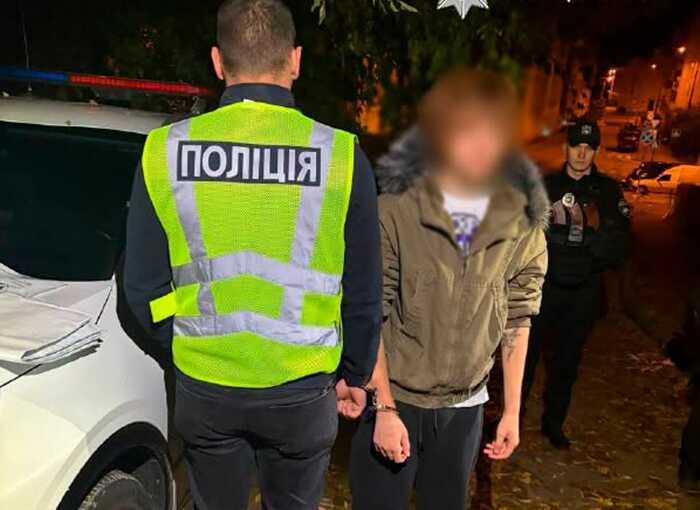
 Law enforcement officers detain the first deputy head of the Odesa Regional Council. Photo — SSU
For this money, the official promised the businessman unhindered processing of permits for the construction of a cottage town near the port city. In case of refusal to pay, the developer was threatened with artificial delays in document preparation. SBU employees documented the crime and detained the suspects after receiving the first part of the bribe in the amount of $10 thousand.
However, several months before this land-construction racket, Radkovskyi managed to become one of the central figures of another cynical scandal related to the embezzlement of humanitarian aid.
The official investigation of the Odesa Regional Prosecutor’s Office and materials of journalistic investigations revealed a scheme where the status of philanthropists was used as a cover for large-scale business. The official recipients of free cargo from abroad were charitable foundations, among which, as writes the publication “Dumska” citing sources in law enforcement agencies, was the foundation “Ridnyi Bereh.”
 How humanitarian aid ended up at the Odesa “7th kilometer.” Infographic by “Telegraph”
All documents for the goods, according to the publication, passed through three charitable foundations: “Doloni Pivdnya”, “Volunteer Wings,” and “Ridnyi Bereh.” Moreover, the latter foundation was supposedly the main one in forging documents for humanitarian aid — the main cargo flow supposedly passed through it.
It is known that the “Ridnyi Bereh” foundation was founded by Oleh Radkovskyi together with Mykhailo Pozhyvanov. The foundation’s details indicate that its founder is LLC “BEREH-GROUP,” owned by Radkovskyi, although the activities of this company, according to YouControl, are currently officially terminated after bankruptcy.
Black accounting and sixty searches
The essence of the operation documented by prosecutors was the banal commercial sale of new clothing and footwear imported into Ukraine as free charitable aid for displaced persons and needy citizens. According to the investigation, from October last year to April this year, the dealers established constant traffic. Humanitarian cargo was delivered by trucks to warehouses in Odesa, after which it was transported to the Odesa industrial goods market “7th kilometer” and sold for money.
 Investigative actions of the National Police in the case of embezzlement of humanitarian aid in Odesa. Photo — National Police
To create an appearance of legality and draw up documents on the alleged transfer of aid between charitable organizations, the participants in the scheme massively forged papers. In fact, the goods were immediately directed for sale.
Interestingly, according to “Dumska,” Oleh Radkovskyi himself at that time actively used the foundation for his own political PR.
“Photo and video reports about supposedly distributed humanitarian aid were published on social networks by Radkovskyi and his party colleague Serhiy Veselov. However, only a tiny part of the goods was used for the reports, while according to documents everything was distributed,” the publication states.
The overall scale of the philanthropists’ machinations is impressive. Law enforcement established that more than 50 tons of humanitarian aid, delivered in 11 separate batches, were sold in this way. The estimated value of the goods exceeds 40 million hryvnias.
To liquidate this humanitarian business, security forces conducted more than 60 large-scale searches. At the trading points of the “7th kilometer” and warehouses, documents on the import and registration of aid, black accounting, mobile phones, and the goods themselves were seized.
Currently, at the request of the Odesa Regional Prosecutor’s Office, the main suspects — including a former customs officer, a representative of a charitable organization, and their foreign accomplice — have been taken into custody with the possibility of posting bail. Radkovskyi himself was not served with suspicion, but the investigation continues to study the role of top officials in this scheme.
If we descend from the level of the Verkhovna Rada and leadership of regional councils to the regional self-government of a settlement scale, the cynicism of the schemes does not decrease. In Mykolaiv region, law enforcement uncovered a scheme where backup generators for invincibility points, intended to save people during power outages, turned into a banal instrument of profit.
The first to receive official suspicion in this case was the head of the Berezanka settlement council, Valeriy Khomitskyi. This leader already had specific criminal experience, as he was previously caught demanding a 200-thousand-hryvnia bribe from a local farmer. Then he admitted guilt, paid a large donation to the Armed Forces of Ukraine, avoided prison, and calmly returned to his work chair.
 Valeriy Khomitskyi and Volodymyr Pohadayev
Initially, investigators charged him with the classic for Ukrainian realities overstatement of equipment cost during tenders with budget funds. However, when law enforcement began to dig deeper into this case regarding the procurement, the participants in the scheme began to massively hide documents from them. They ignored official requests and did everything possible to delay procedural actions.
When security forces through the court finally gained access to the hidden papers of the Berezanka settlement council, the reason for such secrecy immediately became clear. It turned out that the private supplier… did not spend his own money on the goods at all. He simply sold the community what he had received for free.
 How deputies in Mykolaiv region bought free generators for the community. Infographic by “Telegraph”
Prices and fictitious contracts
The official materials of the criminal case reveal the details of the deal. At the end of December 2022, the settlement council concluded a direct contract with an individual entrepreneur (local journalists analyzed the tenders and found out that it was IE Volodymyr Pohadayev). The same name belongs to the current deputy of the Mykolaiv Regional Council. The subject of the commercial contract was the supply of 10 gasoline generators for a total exact amount of 1,299,000 hryvnias.
The investigation established that Pohadayev did not buy these generators. All 10 units of equipment were received by his company absolutely free as humanitarian aid from the charitable foundation “Svitli Spravy.” Free foreign aid, which the foundation transferred for free distribution among Invincibility Points, the deputy simply ran through his IE and sold to his native community at full commercial price.
 Screenshot of the court decision in the case of embezzlement on generators in the Berezanka settlement council
The budget funds received for the free goods successfully went to the accounts of the regional deputy. According to expert calculations, the net losses for the small settlement community on this single batch amounted to more than 700 thousand hryvnias. While the settlement head Valeriy Khomitskyi was sent to pre-trial detention by the court, deputy Volodymyr Pohadayev hastily closed his IE. There is no word yet on suspicion against him.
Interestingly, the founders of the charitable foundation “Svitli Spravy,” which provided these generators for free, are very well-known people in the country. According to YouControl, among its founders in 2020 were listed Viktoriya Arakhamia (wife of MP Davyd Arakhamia) and Hanna Zamazyeyeva, who previously headed the Mykolaiv Regional Council and now heads the State Agency on Energy Efficiency and Energy Saving of Ukraine.
Stories like these prove that, for some officials, human suffering and war have simply become yet another lucrative market. The greed of these local figures has proved stronger than their conscience and common sense, whilst fake charity discredits the very idea of helping others. The main task for the law enforcement system now is to ensure these cases result in actual convictions, as without severe punishment for the guilty, it will be impossible to put a stop to this ‘volunteer business’ built on blood.